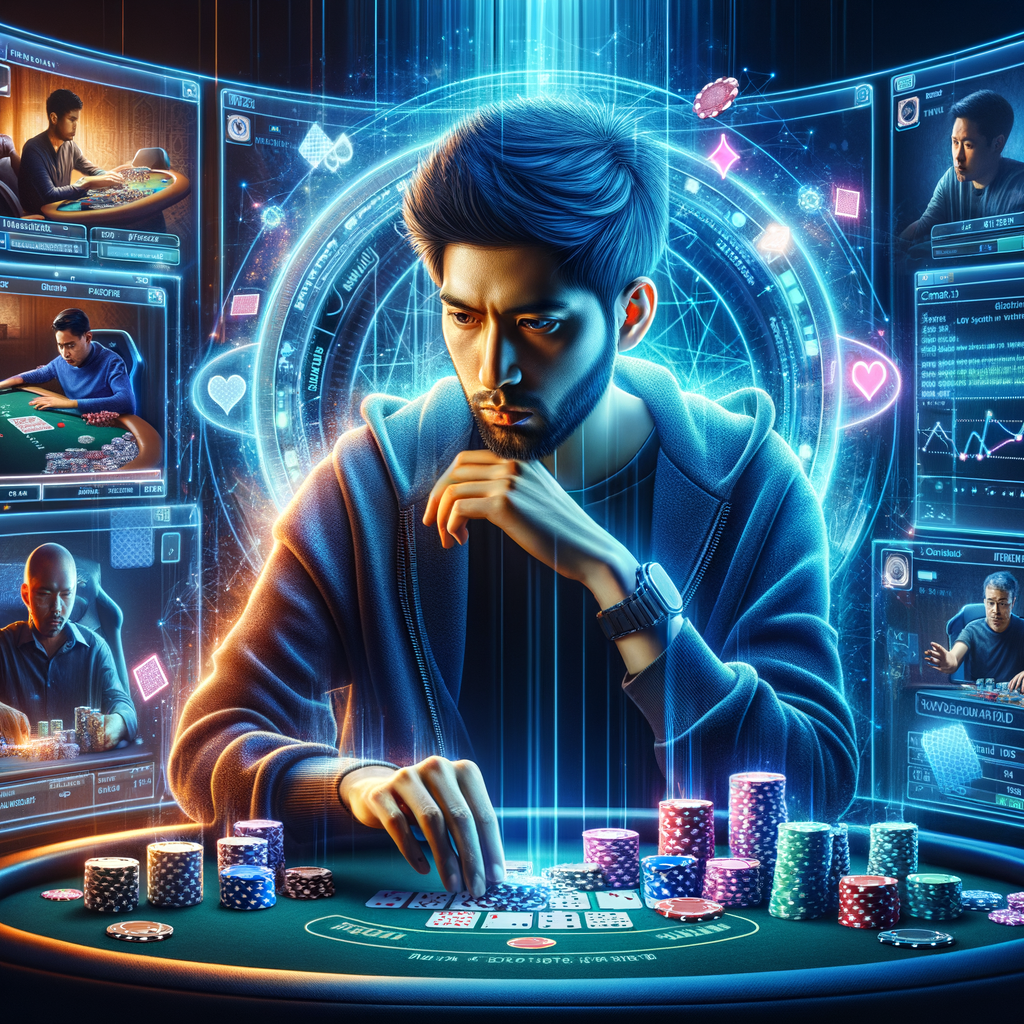
The answer is yes—but that’s the wrong question. AI already beat poker’s best. In 2017, Carnegie Mellon’s Libratus dismantled four elite heads-up specialists for $1.77 million in chips across 120,000 hands. Two years later, Pluribus crushed legends like Chris Ferguson in six-player Texas Hold’em at 5 big blinds per 100 hands, a margin that would bankrupt most professionals. By 2026, the real question isn’t whether machines can win—it’s how humans compete when AI has mastered game theory optimal strategies that took 200 years of poker evolution to discover. The machines didn’t kill poker. They transformed it into something stranger and more demanding than anyone imagined.
The Machines That Changed Poker Forever
January 2017 marked poker’s Kasparov moment. Inside the Rivers Casino in Pittsburgh, four of the world’s best heads-up specialists—Dong Kim, Jason Les, Daniel McAulay, and Jimmy Chou—sat down for what they thought would be a competitive match against Libratus, an AI developed at Carnegie Mellon University. Over 20 days and 120,000 hands of no-limit Texas Hold’em, the machine dismantled them. The final tally: $1,766,250 in chips, an average win rate so dominant that by day fifteen, the pros knew they were outclassed.
Libratus: The Heads-Up Assassin (2017)
What made Libratus different wasn’t brute force computation. Previous poker bots had tried mapping every possible decision tree, a mathematical impossibility in a game with more than 10160 potential scenarios in multiplayer formats. Instead, Libratus used counterfactual regret minimization algorithms, teaching itself by playing trillions of hands against itself and learning from hypothetical mistakes. During overnight sessions, it analyzed the day’s play, identified patterns in how the humans exploited it, and patched those leaks before the next morning. The pros reported something unsettling: Libratus didn’t play like a human. It made bizarre bet sizes—$19,000 into a $30,000 pot, or min-raises in spots where conventional wisdom demanded aggression. These weren’t errors. They were mathematically optimal moves that human intuition had never discovered in poker’s 200-year history.
Pluribus: Conquering Multiplayer Poker (2019)
Two years later, Facebook AI and Carnegie Mellon shattered the final barrier. Pluribus took on six-player no-limit Hold’em, a format exponentially more complex than heads-up. In July 2019, it played 10,000 hands against legends like Chris Ferguson and Darren Elias, achieving a win rate of 5 big blinds per 100 hands—a crushing margin in professional play. The multiplayer challenge required different thinking. Pluribus couldn’t just calculate Nash equilibrium against one opponent; it had to model five different strategic profiles simultaneously while keeping its own strategy unpredictable. The machine didn’t just win. It changed how professionals understood the game itself.
Why Poker Was the Ultimate AI Challenge
When IBM’s Deep Blue defeated Garry Kasparov in 1997, the chess world trembled. When DeepMind’s AlphaGo crushed Lee Sedol in 2016, the Go community reconsidered what human intuition meant. But poker players? They kept shuffling chips with confidence. They understood something computer scientists were just beginning to appreciate: poker wasn’t a calculation problem. It was a deception problem.
The Imperfect Information Problem
Chess and Go share a fundamental characteristic that made them, despite their complexity, algorithmically tractable. Every piece sits visible on the board. Both players see identical information. You can calculate optimal moves by examining the entire game state. Poker operates under radically different rules. Your opponent’s hole cards remain hidden. You’re making decisions in a fog of uncertainty, relying on betting patterns, position, and psychological reads rather than complete information.
This distinction transforms the computational challenge. In chess, Deep Blue evaluated 200 million positions per second to find the best move. In poker, no amount of raw processing power reveals what’s hidden in an opponent’s hand. The AI must build probabilistic models of what cards opponents might hold based on their actions, then construct counter-strategies against multiple possible scenarios simultaneously. It’s not just playing the cards—it’s playing the player.
Computational Impossibility of ‘Solving’ Poker
Six-player no-limit Texas Hold’em presents over 10160 possible decision points. For context, there are roughly 1080 atoms in the observable universe. Researchers at the University of Alberta’s Computer Poker Research Group confirmed that completely solving multiplayer no-limit poker remains mathematically impossible with current—or foreseeable—technology.
Instead, modern poker AI systems like Carnegie Mellon’s Pluribus use counterfactual regret minimization algorithms. These systems iterate through billions of scenarios, gradually approximating game theory optimal strategies without needing to solve every possible hand. Pluribus didn’t memorize poker. It learned to think probabilistically, adapt to opponents’ tendencies, and exploit weaknesses—skills that mirror human expertise but operate at superhuman speed and consistency.
How Modern Poker AI Actually Works
When Pluribus computed its winning strategy in 2019, Carnegie Mellon researchers spent just $144 on cloud computing. That’s roughly what a professional poker player might tip a dealer after a good session. Yet those 12,400 CPU core-hours produced an algorithm that could beat elite professionals at six-player Texas Hold’em—a game with more decision points than atoms in the observable universe.
The breakthrough wasn’t raw computing power. It was mathematical elegance.
Counterfactual Regret Minimization Explained
At the heart of modern poker AI sits counterfactual regret minimization, or CFR—an algorithm that learns by imagining alternate histories. Picture a poker hand where you folded on the flop. CFR asks: what would have happened if you’d called instead? What if you’d raised? The algorithm plays through billions of these hypothetical scenarios, tracking which decisions led to wins and which to losses.
Here’s the critical insight: CFR doesn’t need to remember every single hand. It accumulates “regret” for not taking better actions. If calling the flop would have won $100 more across thousands of simulations, that regret accumulates. Over billions of iterations, the algorithm gravitates toward actions with the least regret. Libratus ran through 15 million core-hours of these calculations before its 2017 match against four top professionals, where it won $1.77 million in chips over 120,000 hands.
The math works because poker hands cluster into patterns. Ace-King offsuit plays similarly whether it’s clubs-spades or hearts-diamonds. CFR exploits these symmetries, compressing trillions of unique situations into manageable strategy buckets.
Game Theory Optimal vs. Exploitative Play
Traditional poker wisdom emphasized exploitative play—if your opponent folds too often, you bluff more. But this creates vulnerabilities. Pluribus instead plays game theory optimal, constructing a balanced strategy across thousands of hand combinations where no opponent can exploit any pattern.
GTO doesn’t mean always making the same play. When Pluribus holds a flush draw on the turn, it might bet 67% of pot size, check-call, or check-fold—randomized according to Nash equilibrium frequencies that make each action unexploitable. The AI calculates optimal bet sizing to fractions of big blinds, mixing strategies so perfectly that even if opponents knew its exact algorithm, they couldn’t profit from it. This is poker’s version of rock-paper-scissors played with infinite complexity.
Human players can memorize GTO frequencies for common spots, but they can’t compute real-time adjustments across 10160 decision points. The machines already do.
The AI Poker Arms Race: Three Landmark Systems Compared
Between 2017 and 2019, three Carnegie Mellon systems redrew the boundaries of what machines could achieve at the poker table. Each iteration solved problems the previous generation couldn’t touch, compressing decades of theoretical advancement into thirty months.
| System | Year | Opponent Configuration | Key Innovation | Computational Requirement | Performance Result |
|---|---|---|---|---|---|
| DeepStack | 2017 | Heads-up (1v1) | Deep learning with limited lookahead depth instead of full game tree calculation | Moderate—processed only 2-3 betting rounds ahead | Defeated professional players with 450 mbb/100 win rate over 44,852 hands |
| Libratus | 2017 | Heads-up (1v1) | Massive pre-computed end-game solutions combined with real-time strategy refinement | Extreme—used Pittsburgh Supercomputing Center’s Bridges system with 15 million core-hours | Won $1,766,250 in chips across 120,000 hands against four top professionals |
| Pluribus | 2019 | Six-player multiplayer | Modified Monte Carlo CFR with depth-limited search, enabling multiplayer Nash approximation | Minimal—ran on just 128 GB RAM using $144 worth of cloud computing | Achieved 5 bb/100 win rate against elite professionals in six-player games |
DeepStack pioneered the critical insight that poker AI didn’t need to map every possible decision point. By using neural networks to estimate hand values beyond a certain depth, it reduced an impossible computational problem to a manageable one. The system looked ahead only two or three betting rounds, then relied on learned intuition—not unlike how humans play.
Libratus took the opposite approach: overwhelming force. It pre-solved 1.4 trillion end-game scenarios before sitting down at the table, then refined its strategy each night based on opponent patterns. The brute-force method worked brilliantly in heads-up play, where tracking a single opponent’s tendencies remained computationally feasible.
Pluribus cracked the exponentially harder multiplayer problem by accepting imperfection. Rather than computing true Nash equilibrium strategies across six players—a problem requiring more computing power than exists on Earth—it used depth-limited search and self-play approximation. The stunning part: it required 1,000 times less computing power than Libratus while playing against five opponents simultaneously instead of one.
Beyond the Felt: Where Poker AI Changes the World
The same algorithms that crushed Phil Galfond and Chris Ferguson at Carnegie Mellon now protect Pentagon networks and guide cancer treatment decisions. Poker AI didn’t just solve a card game—it cracked the code for navigating uncertainty when you can’t see all the variables.
The breakthrough wasn’t teaching computers to bluff. It was developing systems that make optimal decisions with incomplete information, exactly the problem facing a cybersecurity analyst watching network traffic or a doctor choosing between treatment protocols with uncertain outcomes.
Cybersecurity and Defense Applications
When Libratus beat human pros in 2017, the U.S. Department of Defense took notice. The counterfactual regret minimization (CFR) algorithms that let poker bots anticipate opponent strategies across billions of scenarios now detect network intrusions by modeling attacker behavior patterns. Unlike traditional cybersecurity systems that follow predetermined rules, poker-trained AI adapts to novel threats the same way it adjusted to Phil Ivey’s bluff frequencies.
Military strategists at DARPA adapted these systems for resource allocation under uncertainty—essentially multi-player poker with tanks instead of chips. The AI doesn’t need complete battlefield intelligence to calculate optimal troop positioning, just like Pluribus didn’t need to see hole cards to exploit betting patterns.
Medical Decision-Making Under Uncertainty
Oncologists at Memorial Sloan Kettering now use poker AI frameworks to sequence cancer treatments when patient responses remain unpredictable. The technology evaluates treatment paths using the same probabilistic reasoning that determines whether to call a river bet with ace-high:
- Calculate expected value across multiple unknown variables (tumor genetics, treatment response rates, side effect profiles)
- Adjust strategy dynamically as new information emerges from tests and imaging
- Balance exploitation versus exploration—aggressive treatment now versus preserving options for later
The mathematics are identical. A 60% chance your opponent folds to a bluff mirrors a 60% tumor response rate to immunotherapy. Both require betting chips—literal or metaphorical—on incomplete information.
The Bot Epidemic: Online Poker’s Hidden War
PokerStars banned 277 accounts in a single enforcement wave during Q3 2024, confiscating over $1.2 million in suspected bot winnings. The world’s largest online poker platform now deploys neural networks to hunt neural networks—an algorithmic arms race that defines modern online poker more than any tournament headline.
The $86.2 billion online poker market recorded in 2022 creates extraordinary incentive for automated play. With projections hitting $237.5 billion by 2030, every percentage point of that economy attracts sophisticated actors. Today’s poker bots don’t play like the clumsy scripts of 2010 that folded every hand or bet in predictable patterns. They incorporate game theory optimal strategies, randomized timing delays that mimic human hesitation, and decision trees built on the same counterfactual regret minimization algorithms that powered Pluribus to defeat professionals in 2019.
Detection systems scan for superhuman patterns—win rates above 8 big blinds per 100 hands sustained across tens of thousands of hands, bet sizing that perfectly matches GTO solvers, or session lengths exceeding human endurance. But operators face a paradox: the best human players now study solver outputs religiously, making their play patterns increasingly bot-like. How do you ban a machine when professionals deliberately emulate machines?
The technology barrier has collapsed. GitHub repositories offer poker bot frameworks requiring minimal programming knowledge. A computer science undergraduate can deploy a competitive bot in a weekend using open-source AI poker engines. GGPoker responds with behavioral analysis—tracking mouse movements, bet timing distributions, and session patterns. When accounts play 14-hour sessions with decision speeds varying by exactly 1.7 seconds regardless of hand complexity, algorithms flag them.
The economic stakes demand vigilance. Undetected bots grinding $2/$5 tables can extract $40,000 annually per account. Multiply that across networks of bots, and the recreational player pool—the lifeblood of online poker’s ecosystem—faces predatory extraction that makes long-term participation mathematically futile.
How Elite Players Now Train With AI
When Jason Koon prepares for a high-stakes tournament, he doesn’t hire a coach anymore. He opens PioSOLVER on his laptop and runs millions of simulated hands to find leaks in his river play. The world’s best poker players have stopped fighting AI and started using it as their primary training partner.
Professional poker underwent a quiet revolution between 2017 and 2023. After Libratus crushed top pros for $1.76 million in chips and Pluribus proved machines could dominate multiplayer games, the poker elite made a pragmatic choice: if you can’t beat them, learn from them.
GTO Solvers as Training Partners
Today’s tournament preparation looks radically different from the poker education of 2010. Players invest thousands of dollars in solver subscriptions and custom training software that reveals optimal strategies humans never discovered through experience alone. These tools expose previously unknown plays:
- Overbet sizing in specific board textures – Solvers demonstrated that betting 150% of the pot on certain river cards maximizes expected value, contradicting decades of conventional wisdom about “standard” bet sizing
- Mixed strategy frequencies – AI revealed that elite play requires bluffing exactly 33% of the time in specific situations, not the “feel-based” approach humans relied on
- Range construction – Solvers showed that certain hands should be played multiple ways (call, raise, or fold) with precise frequencies to remain unexploitable
The price of GTO+ and PioSOLVER subscriptions ($475-$1,099) has become a standard business expense for any professional earning six figures from poker. Players who resist solver training simply can’t compete at the highest levels anymore.
The New Human Edge: Exploitation Over Perfection
The widespread adoption of solver training created an unexpected problem: when everyone studies the same GTO strategies, the game becomes a battle of who can deviate profitably. Modern elite play involves two distinct skills—knowing the baseline GTO strategy, then recognizing when opponents drift from it.
The human edge in 2026 poker isn’t playing perfectly. It’s noticing that your opponent folds too often to three-bets from the cutoff, or that they overvalue top pair on wet boards. AI taught players the mathematically optimal baseline, but humans still dominate the psychological warfare of exploiting individual tendencies.
2026 and Beyond: The Real Question Isn’t ‘Can AI Win?’
The debate ended in 2019 when Pluribus crushed elite professionals at 5 big blinds per 100 hands. By 2026, asking whether AI can beat poker players is like asking if calculators can beat humans at arithmetic. The machines won. The real question is what happens when every serious player has access to the same GTO solvers that once cost $250,000 in computational resources but now run on a $1,200 gaming laptop.
The democratization of game theory optimal play has fundamentally altered poker’s skill architecture. Tools like PioSOLVER and GTO Wizard have made unexploitable baseline strategies available to anyone willing to spend $249 annually. This accessibility raises the floor dramatically—mediocre regulars in 2026 play tighter preflop ranges and more balanced river strategies than professionals did in 2010. But the ceiling remains stubbornly human. Phil Galfond didn’t win $1.6 million in his 2021 heads-up challenge against VeniVidi1993 by memorizing solver outputs. He won by recognizing psychological patterns and exploiting deviations from equilibrium that no algorithm suggested.
The evolution from Libratus’s 2017 domination to today’s landscape reveals poker’s paradox: AI solved the mathematical game but couldn’t kill the human one. The machines taught us that perfect play exists, then showed us why perfect play isn’t enough when your opponent makes mistakes. Every fold to a bluff, every crying call with second pair, every tilt-induced overbet represents exploitable value that GTO strategies deliberately ignore in pursuit of unexploitability.
Poker’s future belongs to a hybrid species—players who’ve internalized GTO foundations through thousands of hours studying solver outputs, then learned when to abandon those strategies to exploit human psychology. The best players in 2026 use AI as a training partner to build their baseline, then rely on pattern recognition, emotional intelligence, and adaptive thinking to deviate profitably. They understand that while Pluribus can calculate Nash equilibrium across 10160 decision points, it can’t detect the micro-expression when an opponent checks top set on a wet flop or the timing tell that screams missed draw.
The machines won the battle for optimal play. But the war for poker supremacy remains distinctly, defiantly human—fought not with perfect strategies, but with the messy, beautiful ability to read fear, greed, and tilt across a felt table. That’s the game AI can’t play, and the one that will keep poker alive long after every solver strategy has been memorized.