
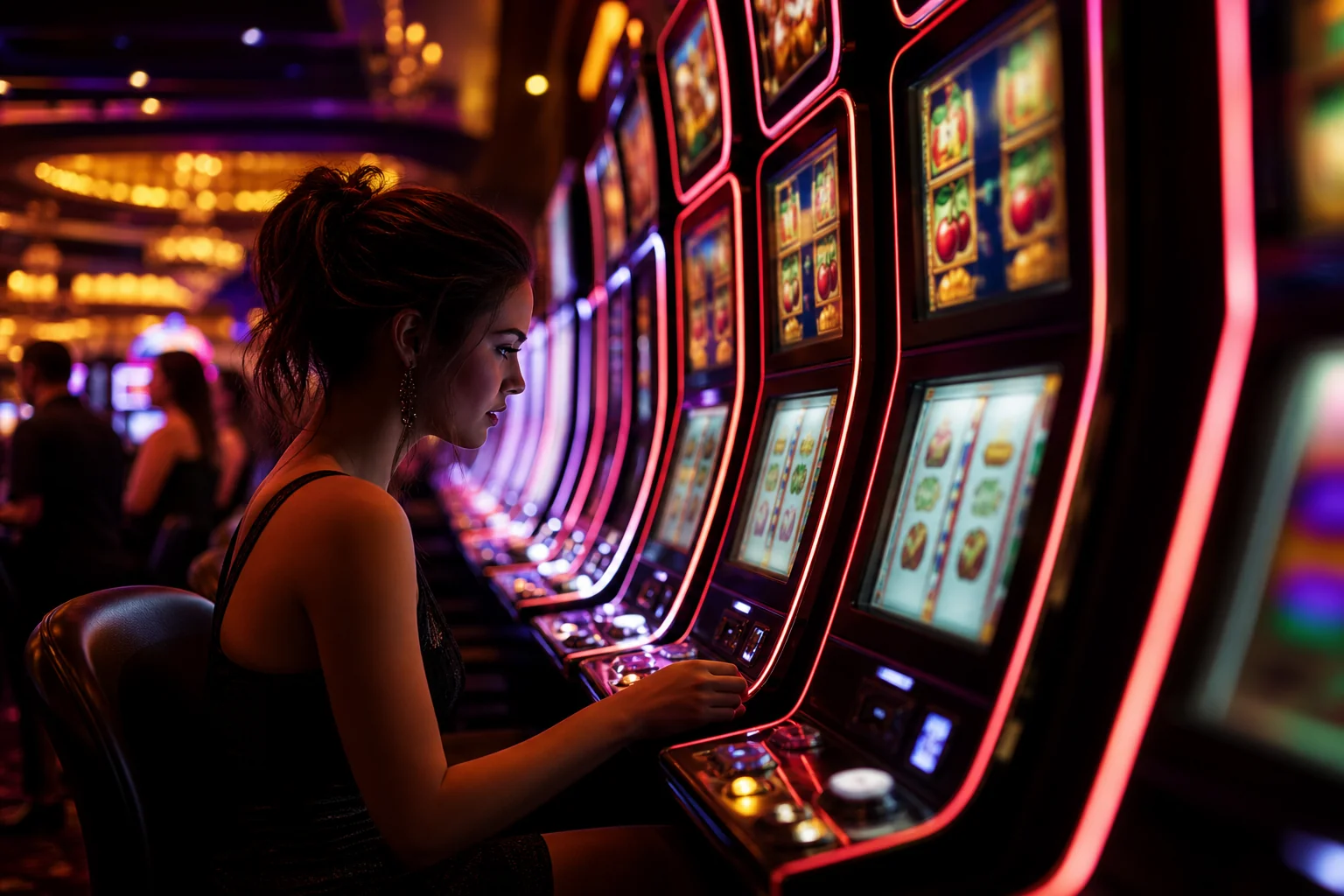
Step onto any casino floor and the assault begins immediately: a thousand LED lights cycling through neon rainbows, triumphant jingles erupting from every corner, cascading animations celebrating wins that aren’t really wins. Nothing here is accidental. Every flash, chime, and animated burst has been engineered using decades of psychological research, neuroscience findings, and millions in R&D investment. This spectacle traces its lineage from Charles Fey’s simple mechanical bell in 1895 to today’s sensory-optimized video slots that exploit specific quirks in human neurology. This article unpacks the evolution of slot machine design, the mathematics of losses disguised as wins, the neuroscience behind near-miss effects, and the behavioral conditioning techniques that keep players locked in “the zone” for hours at a time.
From Bell Rings to Digital Symphonies: The Evolution of Slot Machine Sensory Design
The Liberty Bell: Where It All Started
Charles Fey didn’t set out to create a psychological weapon when he built the Liberty Bell in 1895. The San Francisco mechanic simply needed a way to alert bar owners when his three-reel machine paid out. His solution? Mount an actual bell inside the cabinet that rang whenever three liberty bell symbols lined up, triggering an automatic payout of fifty cents. That bell wasn’t marketing genius—it was practical necessity in an era before electric lights and digital displays.
But Fey stumbled onto something profound. The bell’s ring created an instant Pavlovian response in nearby patrons, announcing a winner and drawing crowds to the machine. Within months, saloon owners reported that the sound alone drove more play than silent competitors. The auditory tradition in slot design was born from pure accident, a functional feature that became the industry’s first psychological hook.
The Video Revolution of the 1970s
For eight decades, mechanical slots remained remarkably similar to Fey’s original design—spinning reels, clinking coins, simple bell chimes. Then Fortune Coin Company introduced the first true video slot machine in 1975, installing a modified Sony television inside a cabinet at the Las Vegas Hilton. The gambling world yawned. Players distrusted the pixelated reels, and casinos worried about hacking.
By the mid-1980s, that skepticism evaporated. International Game Technology acquired the video slot patents and unleashed designers from mechanical constraints. Suddenly, slot machines could display cascading symbols, animated characters, layered soundtracks, and bonus rounds that felt like video games. A mechanical reel could produce perhaps a dozen distinct sounds. A video slot could generate thousands of unique audio-visual combinations, each calibrated to specific game states.
The transformation accelerated through the 1990s and 2000s as computing power exploded. Slot manufacturers began hiring cognitive psychologists, film composers, and neuroscience consultants. Companies now invest millions annually in sensory research labs where eye-tracking cameras and biometric sensors measure player responses to different light patterns, sound frequencies, and animation speeds. What started as Charles Fey’s practical bell has evolved into a multimillion-dollar science of engineered excitement.
The Neuroscience of Celebration: How Your Brain Responds to Wins (and Near-Wins)
When two sevens line up on the payline and the third stops one position away, your brain doesn’t register disappointment—it registers excitement. Neuroimaging studies have revealed that near-miss outcomes activate the ventral striatum, the same reward-processing region that lights up during actual wins. This wasn’t an accident of evolution; slot manufacturers have engineered their machines to exploit this quirk of human neurology with surgical precision.
The Near-Miss Effect
Research published in Nature Neuroscience demonstrated that near-miss scenarios trigger activity in the ventral striatum comparable to genuine victories, even though players receive no payout. The brain interprets these close calls as evidence of skill improvement rather than random chance, creating what neuroscientists call a “learning signal” that encourages continued play. Data from independent testing labs reveals that near-miss outcomes occur approximately 30% more frequently than pure probability would dictate—manufacturers deliberately program reels to stop just short of winning combinations at rates that maximize this neurological response.
The effect becomes more pronounced on modern video slots where near-misses can occur across multiple dimensions simultaneously: on the main payline, on adjacent lines, or in bonus trigger sequences. A player might see scatter symbols appear on reels one and two, priming anticipation for the third reel, only to watch it land one position off. Each near-miss fires another burst of neural activity, keeping the ventral striatum engaged.
Musical Psychology and the C-Note
Slot machine audio designers favor the C-note interval because it creates what musicologists call a “perfect resolution”—a harmonic progression that signals completion to the auditory cortex. When combined with synchronized LED lighting that can cycle through millions of color combinations, these multisensory experiences amplify dopamine release beyond what either stimulus could achieve independently. The timing matters too: manufacturers program light-and-sound sequences to peak at 200-300 milliseconds after a win registers, matching the brain’s natural reward-processing delay and creating the sensation that the celebration is building organically rather than triggering mechanically.
Losses Disguised as Wins: The Psychology of Fake Victories
You bet $2.50 across 25 paylines. The reels spin. Three symbols line up on line 14. Bells chime, lights flash, and the screen erupts in celebration. Your win? Seventy-five cents. You just lost $1.75, but your brain registers victory.
This is the losses disguised as wins phenomenon, and it happens in approximately 30-40% of spins on modern multi-line slot machines. The math is brutally simple: when your payout is smaller than your total bet, you’ve lost money. But the machine doesn’t see it that way. It treats any payout as cause for celebration, deploying the same sensory arsenal—cascading coins, triumphant jingles, animated bursts of color—that accompanies genuine wins.
The confusion is intentional. Multi-line slots, which became dominant in casinos during the late 1990s, allow players to bet on dozens of paylines simultaneously. This architecture creates countless opportunities for small wins that don’t offset the total wager. A player might win on five different paylines in a single spin, triggering five separate victory sequences, while still walking away with less money than they started.
Researchers at the University of Waterloo documented this effect by tracking brain activity during LDW events. The striatum, a region associated with reward processing, lit up during these fake victories almost identically to genuine wins. Players reported feeling like they were winning even as their bankrolls steadily declined. One study participant, after losing $40 over 200 spins, claimed to have “broken even” because the constant stream of celebratory feedback had distorted their perception of the session.
The result: players stay at machines longer, chase losses more aggressively, and fundamentally misunderstand their win rate. The spectacle doesn’t just enhance the experience. It rewrites the definition of losing.
The Sound Design Arsenal: Over 100 Effects Per Machine
Walk past a bank of modern slot machines and you’re hearing the output of a small recording studio’s worth of work. Each machine contains over 100 distinct audio effects, meticulously engineered to keep you engaged. These aren’t random bleeps and chimes. They’re the product of sound designers who understand that a well-timed celebratory jingle triggers the same neural pathways as winning actual money.
The complexity rivals video game sound design. Machines track every action—button press, reel stop, symbol landing, bonus trigger—and respond with carefully calibrated audio. A cherry landing on the payline gets a different pitch than a seven. Three matching symbols produce layered harmonics that signal “reward” before your brain consciously registers what happened. The goal is simple: make you feel like you’re winning more often than you actually are.
The Hierarchy of Victory Sounds
Slot manufacturers program sounds to scale with win size, creating what psychologists call a “reward hierarchy.” Small wins (anything under your bet amount) get brief, pleasant tones lasting 1-2 seconds. Medium wins trigger 5-8 second celebrations with multiple instrument layers. But jackpots? Those unleash 15-20 second audio spectacles—crescendoing music, cascading chimes, triumphant fanfares that announce your victory to everyone within earshot.
This duration isn’t arbitrary. Extended celebration sequences serve two functions: they cement the emotional high in your memory, making that win feel more significant than its dollar value, and they advertise success to other players, creating social proof that “this machine pays.”
What Happens When You Mute the Machine
Kill the sound and the spell breaks. Research demonstrates that muting slot machines dramatically reduces playing time and—critically—diminishes players’ perception that they’re winning. Without audio feedback, losses disguised as wins (where you “win” less than you bet) register as the losses they actually are. The cheerful ding that made a $0.75 return on a $1.00 bet feel like victory disappears, leaving only cold mathematics. Casinos know this, which is why you’ll rarely find a mute button prominently displayed.
B.F. Skinner’s Legacy: Variable Ratio Reinforcement in Action
In the 1950s, Harvard psychologist B.F. Skinner placed pigeons in boxes and taught them to peck levers for food pellets. When he delivered rewards on an unpredictable schedule—sometimes after two pecks, sometimes after twenty—the birds became obsessed. They pecked faster and longer than pigeons rewarded on any other schedule, continuing even when food stopped coming entirely. Skinner had discovered the variable ratio reinforcement schedule, the most powerful conditioning technique in behavioral psychology.
Sixty years later, slot machine designers would weaponize his findings.
Unlike fixed ratio schedules, where rewards arrive at predictable intervals, variable ratio reinforcement delivers payouts randomly. You might win on your third spin, then not again for forty-seven spins, then twice in five spins. This unpredictability triggers a neurological response that fixed patterns cannot match. The brain’s reward system stays perpetually engaged because the next pull might be the big one—a possibility that never diminishes.
Skinner’s pigeons and slot players share identical behavioral patterns. Both develop what psychologists call “extinction resistance”—the tendency to continue a behavior long after rewards cease. A pigeon trained on a variable ratio schedule will peck thousands of times without food. A slot player will feed hundreds of dollars into a cold machine, convinced the drought must end soon.
This conditioning operates below conscious awareness. Players understand intellectually that each spin is independent, that machines have no memory, that previous results don’t influence future outcomes. Yet the variable ratio schedule overrides logic. It’s why casinos profit, why players return, and why Skinner’s legacy extends far beyond academic psychology into the architecture of modern gambling.
Entering ‘The Zone’: How Rhythmic Stimuli Create Time Distortion
Anthropologist Natasha Dow Schüll spent fifteen months embedded in Las Vegas casinos studying slot machine players, and what she documented was startling: players routinely lost track of hours, missed meals, and forgot about appointments while sitting at machines. They weren’t simply distracted. They had entered what researchers and players alike call “the zone”—a dissociative state where time perception collapses and the world outside the machine ceases to exist.
Casino designers engineer this state with surgical precision. The rhythmic patterns—the three-second spin cycle, the metronomic whoosh of reels, the predictable burst of celebratory sounds—create a hypnotic cadence that lulls players into what cognitive psychologists recognize as a flow state. Unlike the positive flow state athletes or artists experience, this version serves the house. The repetitive animations synchronize with sound effects to establish a sensory metronome. Each spin follows the same temporal pattern: anticipation, resolution, reward feedback, reset. This predictability doesn’t bore players; it entrances them.
The phenomenon mirrors what happens during highway hypnosis or meditation. The brain, encountering consistent rhythmic input, begins to automate responses. Players stop consciously deciding to spin. Their finger presses the button before they’ve processed the previous outcome. Schüll’s research revealed that players weren’t chasing jackpots in the zone—they were chasing the zone itself, a state of suspended consciousness where anxiety, financial stress, and life problems dissolved into pure mechanical rhythm.
Studies show that players rate their gambling experience 40% more positively when audio-visual feedback is present compared to silent conditions. That preference isn’t about entertainment value. It’s about how effectively the sensory symphony pulls them out of normal time and into machine time, where three hours can feel like thirty minutes and a $500 loss registers only as an abstract number on a screen.
The Bottom Line: Revenue Impact of Sensory Design
Casino operators don’t invest in dazzling light arrays and immersive soundscapes out of artistic passion. They do it because the numbers justify every dollar spent. Machines equipped with enhanced audio-visual features generate approximately 25-30% more revenue per unit than their basic counterparts, according to American Gaming Association data. For a single machine earning $200 per day in a mid-tier casino, that’s an extra $50 daily—or roughly $18,000 annually per cabinet.
The global slot machine market, valued at over $8 billion, continues to prioritize sensory innovation as its primary competitive advantage. Manufacturers like Aristocrat, Scientific Games, and IGT allocate substantial R&D budgets specifically to refining the psychological triggers embedded in lights, sounds, and animations. The return on investment proves substantial: a machine costing $25,000 with premium sensory features typically recovers its additional cost premium within 6-8 months through increased play duration and higher bet frequencies.
This explains why casino floors undergo constant technological refreshes. Older mechanical machines and early video slots without sophisticated sensory feedback get relegated to low-traffic areas or removed entirely. The economics are straightforward:
- Enhanced sensory design increases time-on-device by keeping players engaged longer
- Longer sessions translate directly to higher theoretical win for the house
- Players perceive sensory-rich machines as more entertaining, driving repeat visits
- Premium positioning justifies higher minimum bets on feature-heavy cabinets
For casino executives, sensory design isn’t a luxury—it’s the most reliable lever for extracting maximum revenue per square foot of gaming floor.
The Spectacle and the Science
From the Liberty Bell’s single chime to today’s orchestrated sensory experiences, the evolution of slot machine design represents one of the most successful applications of behavioral psychology outside a laboratory. Every light flash is timed to dopamine release patterns. Every sound effect scales to reward hierarchies. Every animation sequence is calibrated to keep you in the zone just a little longer. Casino operators and manufacturers have invested decades of research and billions in development to perfect these mechanisms, and the results speak for themselves in revenue figures that justify every dollar spent.
Understanding how these systems work doesn’t immunize you against their effects—the variable ratio reinforcement schedule operates below conscious thought, and your ventral striatum will light up for near-misses whether you know the neuroscience or not. But awareness changes the equation. When you recognize that the celebratory explosion accompanying your $0.75 “win” on a $2.50 bet is engineered deception, when you understand that the zone isn’t flow but dissociation, you gain a foothold against the spectacle.
The intersection of entertainment design and behavioral conditioning has produced machines that are extraordinarily effective at what they do. The question isn’t whether the lights and sounds work—it’s whether you’ll let them work on you.